
Hydraulic separation gives heat pump chillers control of their own flow and keeps building-side design and commissioning straightforward.
I came to Nyle® a few years ago after 25 years of designing hydronic systems, 15 years of which were heavily focused on new construction and retrofit projects using air-to-water heat pumps.
In that time, I used equipment from a variety of manufacturers, and one thing was always true: the first time I used a new piece of equipment, I’d get burned by something, usually late in the project. Documentation was spotty, information was hard to get, the equipment had limitations hidden by marketing spin and overzealous salespeople, and I would have to adjust designs unexpectedly… sometimes during commissioning!
The difficulty and complexity of those projects are what drove me toward manufacturing in the first place. I wanted to be a part of removing the unnecessary difficulty associated with these projects and help make this technology easier to deploy. As Nyle moves beyond solely domestic hot water, and into building space heating and cooling systems, I hold these principles firmly in mind: be clear, be honest, and keep it simple. I believe this will help this technology succeed through design and into the field.
With modern heat pump chillers being fully modulating, self-controlled equipment that can do so much more than their older ancestors, a big part of these projects are kept simple, predictable, and reliable by using primary-secondary piping techniques. This eliminates a large number of integration challenges, and makes the design of the heat pump system far simpler and easier on many levels.
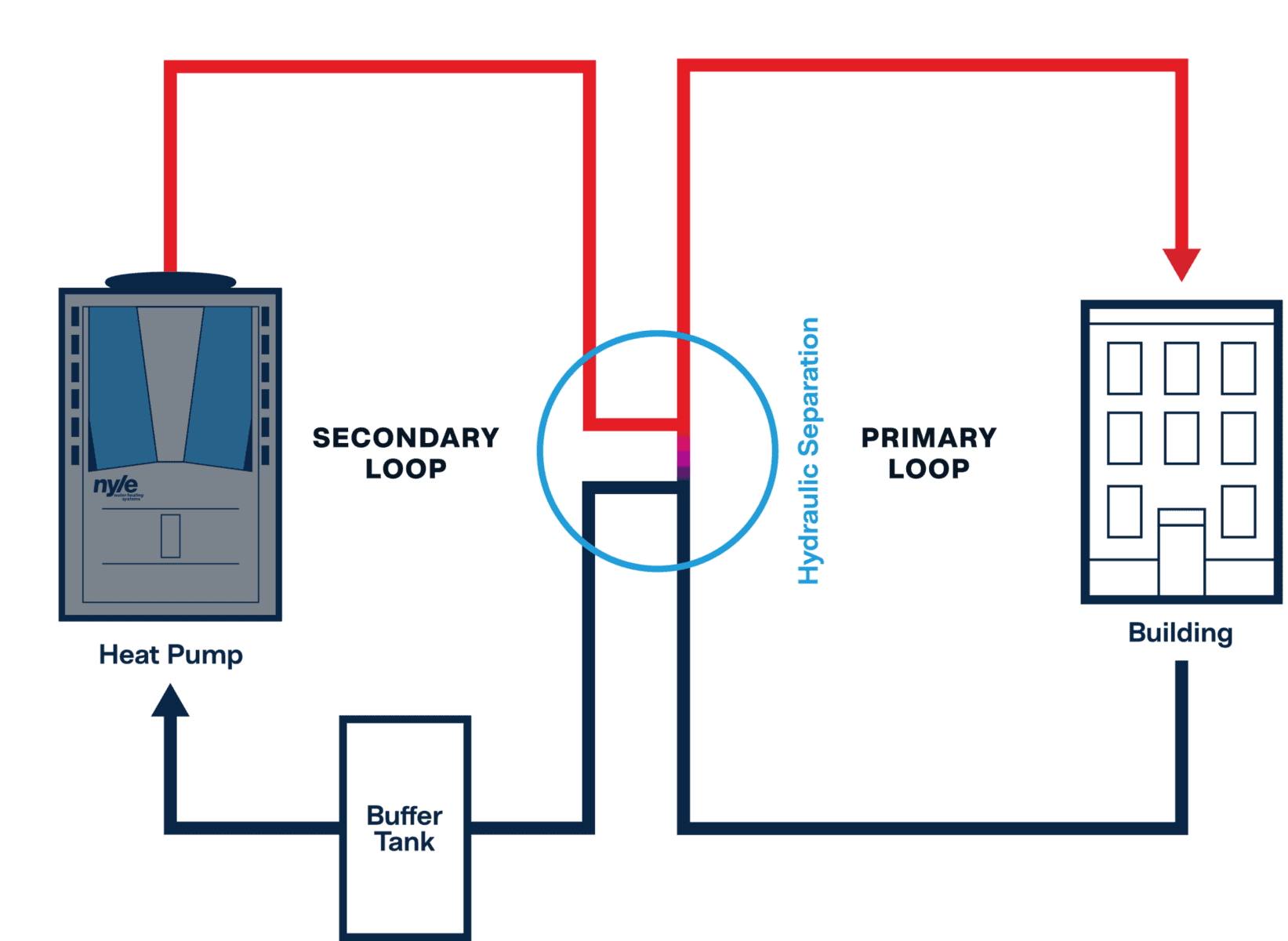
What is primary-secondary piping?
Primary-secondary piping is a way to achieve “hydraulic separation” in a hydronic system. In simple terms, it allows a designer to completely decouple the flow rates in two connected piping circuits, so circulators in one part of a system do not interfere with another part of the system, while allowing the two circuits to interact as needed to transfer heat.
This is achieved by keeping the pressure differential at the connection points between the circuits as close to zero as possible. Closely spaced, generously sized tees with low flow velocity between them can achieve this, or specialty devices like hydraulic separators or 4 port buffer tanks can also provide this hydraulic separation.
Why primary secondary piping matters for heat pump chillers
Tero™ heat pumps, with variable speed circulators and onboard control logic, can control their own operating conditions to a very high degree. This has several key benefits compared to “variable primary” systems in which the heat pump is always subjected to the instantaneous flow rates and return water temperatures presented by the building:
Protection: Control the heat pump operating conditions
By controlling its own flow rates, the Tero can manipulate its own rate of heat extraction in different conditions. This allows the heat pump to help ensure it is operating in its safe compressor operating envelope at all times and at optimal efficiency, regardless of what is happening in the building or outside. Staying in the envelope is essential for compressor longevity and long term performance.
Simplicity: Makes each circuit easier to design
Primary-secondary piping does not make the system more complicated. It makes each loop easier to design. By decoupling from the building’s flow conditions, circulator and pipe sizing in the building remains unaffected, and the two circuits can be considered independently, allowing right-sizing on both sides of the system. Also, control integration is simpler, and the heat pump installation can be designed with only minimal consideration for the building conditions. Ensure the heat pump is able to provide your target LWTs at high and low ambient conditions, size to your capacity requirements, and pass your heating and cooling demands to the heat pump. That’s it.
Control: Improves response to changing loads
By decoupling the heat pump from the building’s current load conditions, and with an appropriately sized buffer volume, the Tero can then respond intelligently and safely to building loads that can change rapidly and frequently. Compressor and staging modulation can be managed at a more measured pace, minimizing overshoots and short cycling, and allowing for consistent, reliable performance.
Why Nyle requires primary-secondary piping for Tero
Nyle is focused on ensuring that Tero designs and installations are successful for everyone, from the designer to the building owner. With the integral EC circulators onboard, and generous available head for pipe losses, designing and installing a heat pump circuit with the Tero is as simple as it can possibly be, with minimal points of potential failure. No third party pump staging controls, no interference with the building circuit design, just the fundamentals of temperature and flow sizing. Installers can easily and intuitively understand the piping system. And building owners will enjoy the redundancy that allows the system to keep operating even when maintenance is required.
These systems don’t have to be complicated. Let’s keep it simple!
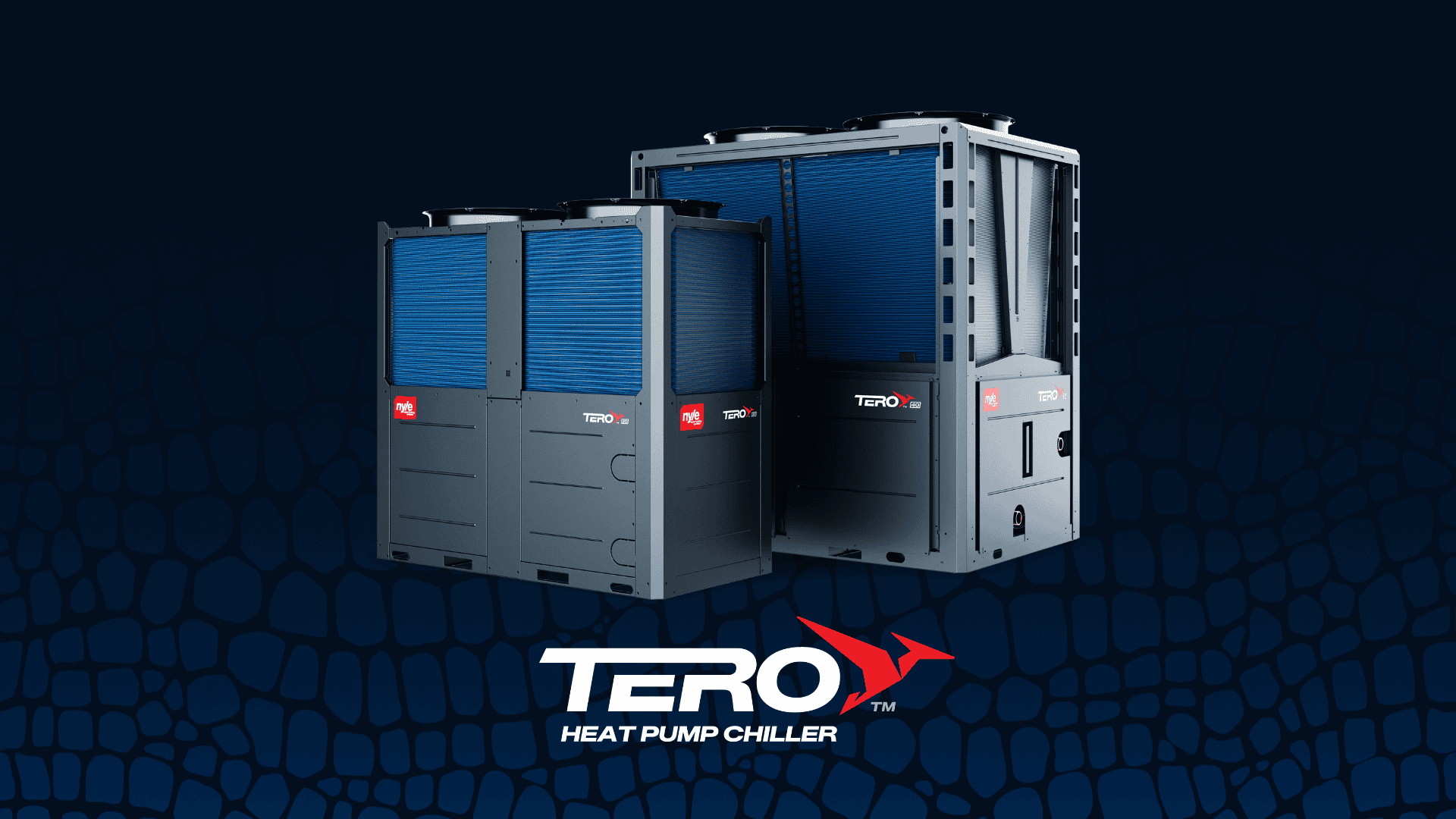
About the Tero Series heat pump chillers
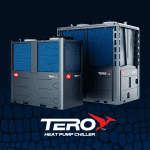
The Tero Air Source Heat Pump Chiller is an exciting new product line for the commercial hydronic space heating and cooling market. With high leaving water temperatures, excellent cold climate performance, minimal buffer volume requirements, and many innovative and interesting control features, it can be a cost effective and easy to deploy solution for decarbonization projects in many climates. The series included the Tero 20 and Tero 40.