
Nyle’s current position and the engineering trade-offs that matter
Nyle Water Heating Systems continuously evaluates the refrigerant landscape for high-temperature applications like domestic hot water and space heating. We consider performance, safety, total cost of ownership, serviceability, and how systems behave across real ambient conditions.
Our staff includes engineers with personal experience designing transcritical carbon dioxide (CO2/R744) heat pump water heating products. Here is why we do not plan to pursue development of a CO2 (R744) product.
What CO2 Really Offers
The primary advantage of R744 is its “future-proof” global warming potential of 1 and its non-flammable properties compared to other options in this GWP range. CO2 can work efficiently in very high Delta T applications like industrial refrigeration and certain cascade systems.
Beyond that, there are no unique technological advantages. CO2 (R744) systems use the same heat exchangers, component, and controls manufacturers as everyone else, but at a higher price point to handle higher pressures and the unique characteristics of CO2. Compared with many synthetic refrigerants and naturals like propane R290, this pressure class drives cost and service complexity.
Bottom-up Reality
Higher operating pressures demand thicker copper evaporators, special condensers/gas coolers, specific compressors, flash tanks, ejectors, secondary gas coolers, and accommodations for every component or sensor in contact with refrigerant. Several of these parts have only been commercially available for five years. They are not widely available as service parts, and product families remain in flux, which makes like-for-like replacement hard later. Field service also must deal with refrigerant leaks at high pressure.
You must place severe limits on the operating envelope to prevent runaway pressures in the transcritical regime. Effectively you cannot exceed entering water temperatures over 86°F (CO2’s critical point near the boiling point of the supercritical transition) without kneecapping capacity/efficiency or triggering extraordinary, exponential increases in system pressure. As condensing and evaporating temperatures converge, pressure rises the same way and forces similar interventions.
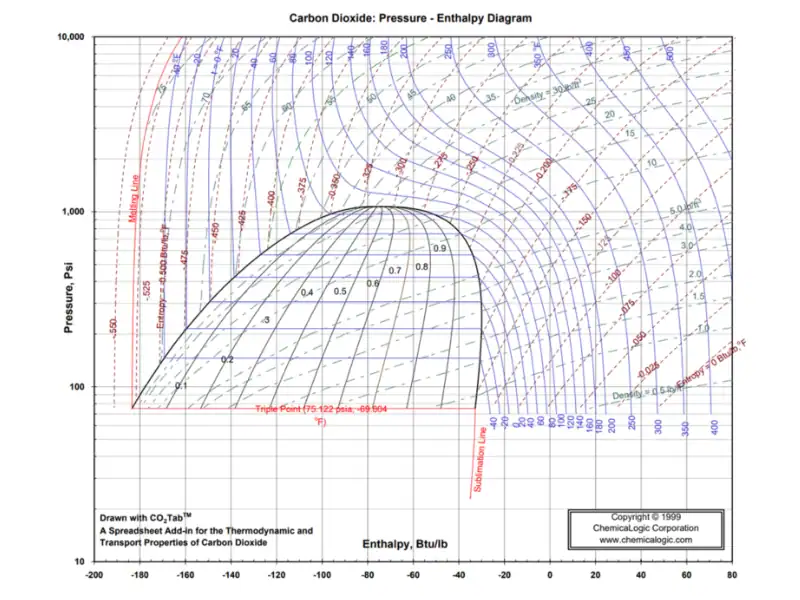
This kills off CO2 for space heating and severely limits its use for domestic hot water in recirculating DHW systems. This is why single-pass with swing tanks exists in the first place.
Cost and Scale
CO2 components cost more. Without massive scale, they struggle to compete with lower-pressure refrigerants. Our installed cost versus CO2 in Seattle is as much as half the price, according to a well-known Seattle engineering firm, who evaluated all available options independently.
What the Global Market Signals
When we look for a path to wider R744 adoption in our segment, we watch Europe and Asia. At the DOE Ultra Low GWP Summit, Fraunhofer-Gesellschaft presented that CO2 represented less than 3% of new products introduced at ISH 2024, and that share appears lower in 2025. Product development is dominated by HFOs and A3 natural refrigerants. There is more investment in ammonia than CO2. CO2 is not on track to see production cost reductions or adoption that keep pace with A3s like propane (R290), isobutane, and cyclopentane.
In our heat pump size class, despite being in the market longer than many HFOs, CO2 has significantly less market share.
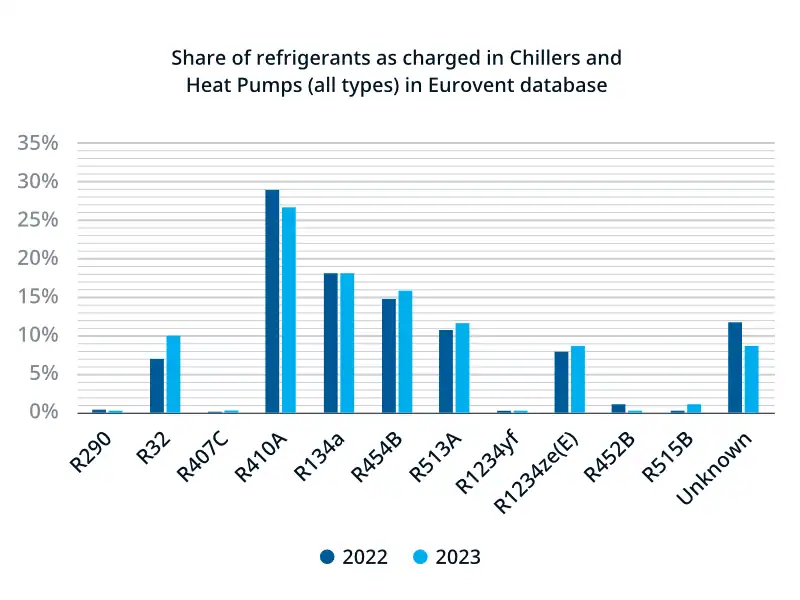
This story has played out with multiple OEMs. Japan’s market has replaced a popular CO2 heat pump with inexpensive R32 units. A leading heat pump manufacturer introduced another product from Europe that uses R454C (at less than half the cost), because CO2 has not competed well globally. They offer no other CO2 heating products and use R513A in European water-source heat pumps. Another US CO2 heat pump manufacturer, who you know, is importing an R513A heat pump to augment its CO2 line. It has sold very few CO2 units and is seeking an HFO line.
All of these products are technological dead ends in our class and are being replaced by HFOs in North America or propane R290 elsewhere.
"In our heat pump size class, despite being in the market longer than many HFOs, CO2 has significantly less market share."
Safety and Service
From a technician safety perspective, here are the handling considerations for CO2 according to Copeland who makes a significant amount of R744 components for refrigeration:
- Asphyxiation
- High system operating pressures
- Trapped liquid
- Dry ice
- Freeze burns
I personally took a hit from the high side from over ten feet away during R&D testing on a unit prior to my time at Nyle. The number of qualified technicians for supermarket and industrial CO2 (where pressures are lower than in heating) is already minimal. Under heating pressures, there is practically no one qualified to work on them. This scarcity pushes replacements over repairs and raises total cost of ownership.
Efficiency in Real-life Buildings
CO2 gets lauded as a cold-climate killer. Reality: unless you maintain an extraordinary Delta T, and unless you account for heat exchange losses, defrost, secondary-loop pump power, and controls, CO2 is no more efficient than other refrigerants in practice. A study of the Mitsubishi QAHV showed average SysCOP 2.4 (without the swing tank) during Seattle shoulder season at an average of 40–70°F.
Additional Points for Colder Weather
Defrost and hot-gas bypass hurt performance enough that some heat pump makers apply N+1 on projects to cover defrost derate. With entering water temperature in the 90s, COP falls near 1. CO2 can make very hot water well below 0°F thanks to transcritical operation, but it does so almost entirely on compressor power. Below ~5°F, COP falls off a cliff. Sizing a design-day load below 0°F on CO2 units is unreasonable; electric resistance will be cheaper and more efficient at those extremes.
Nyle’s Current Position
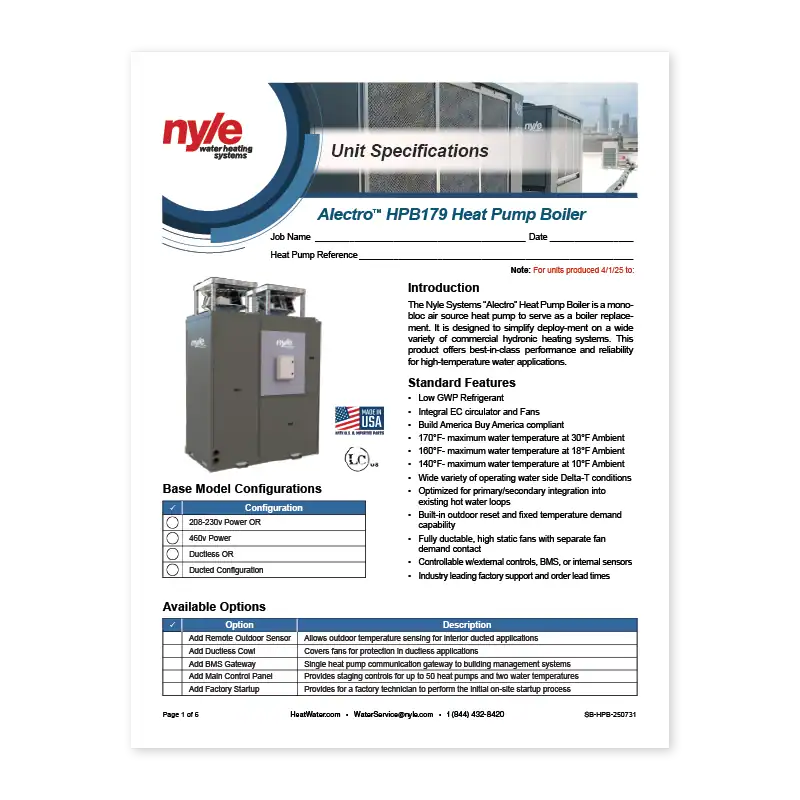
Competitively, our products are cheaper per BTU installed, cheaper to maintain, built in the United States from domestically available components, and NSF/ANSI 61 rated for potable hot water. Return-to-primary single-pass is coming with our new products and will unequivocally show the fundamental weaknesses of CO2 for commercial DHW under common ambient conditions.
As it stands today, R744 is a dead end for heating applications, and anyone deploying it will regret doing so as the equipment ages out.
Context We Continue to Track
We will keep monitoring policy and technology developments tied to greenhouse gases, PFAS chemicals, and alternatives like propane R290. If the evidence shifts on cost, service, safety, or performance, we will reassess.